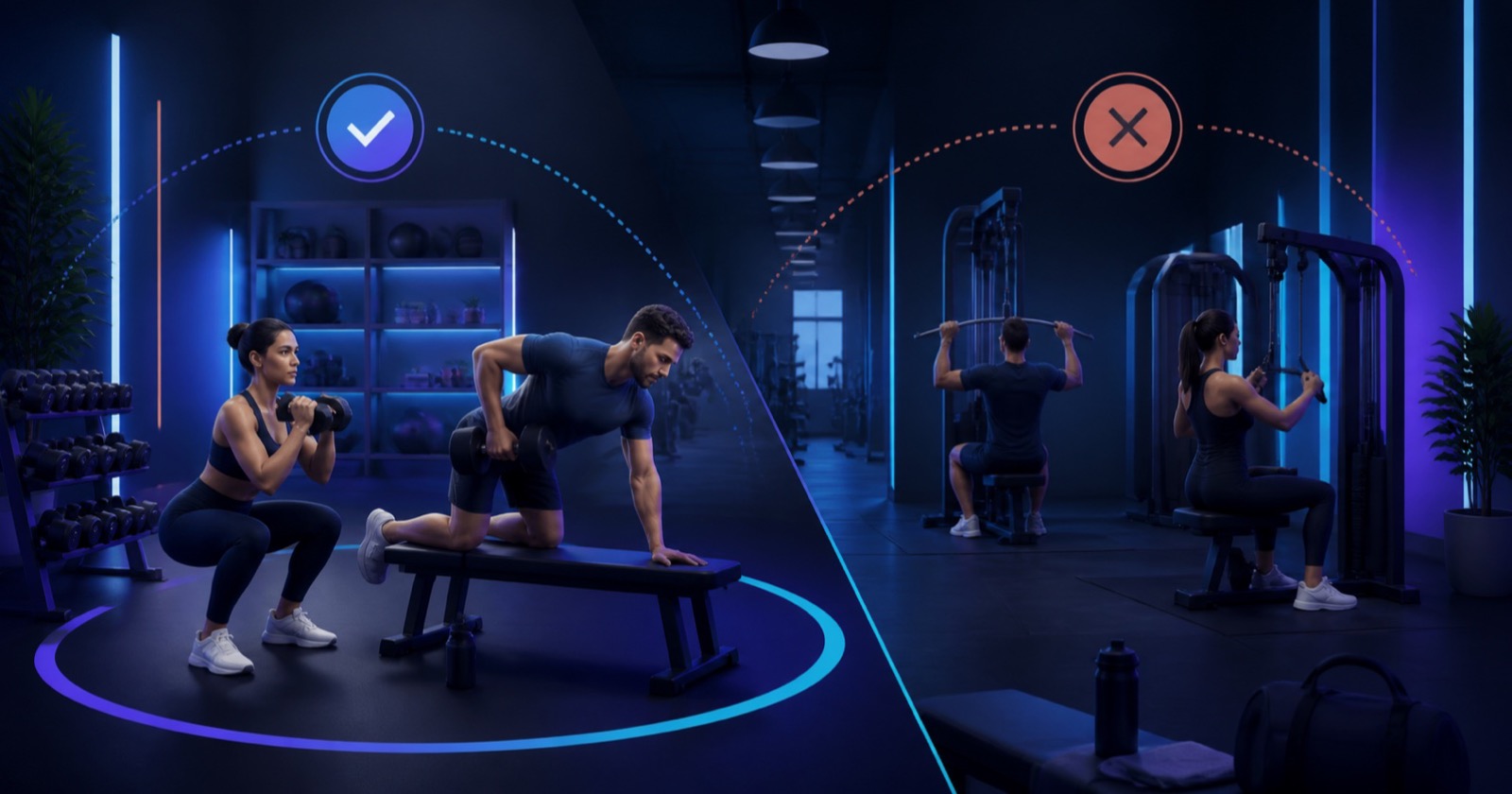
Supersets look efficient on paper: perform one exercise, move to the next, then rest. In a real gym, the quality of the pairing depends on much more than muscle groups.
The four-part superset test
- Distance: can you reach the second exercise in a few steps?
- Availability: can you reasonably hold or share both stations?
- Setup: does switching require a long plate, pin or bench adjustment?
- Intent: does the second movement complement the first without ruining technique?
If the answer to any of these is no, two individually good exercises can still form a bad superset. AnyGear uses location information to improve the distance part, but the busy floor still deserves your judgment.
When to break the pair
If someone needs the second station, turn the block into straight sets or choose a nearby alternative. Protecting the exact pairing is less important than preserving good work and reasonable rest.
A useful superset saves time without creating social friction, rushed setup or compromised technique.
Tip: accessories are often the easiest win
Major compound lifts usually deserve attention and predictable recovery. Smaller accessory movements are often easier to pair, especially when they share a cable tower, dumbbell rack or floor area.
Evidence note
A 2025 systematic review and meta-analysis found that supersets can shorten sessions while producing broadly similar long-term adaptations, but they also increase perceived effort. A controlled trial likewise found similar strength and hypertrophy outcomes with substantially shorter sessions, alongside greater session discomfort. That supports using supersets selectively—not treating every pairing as automatically superior.