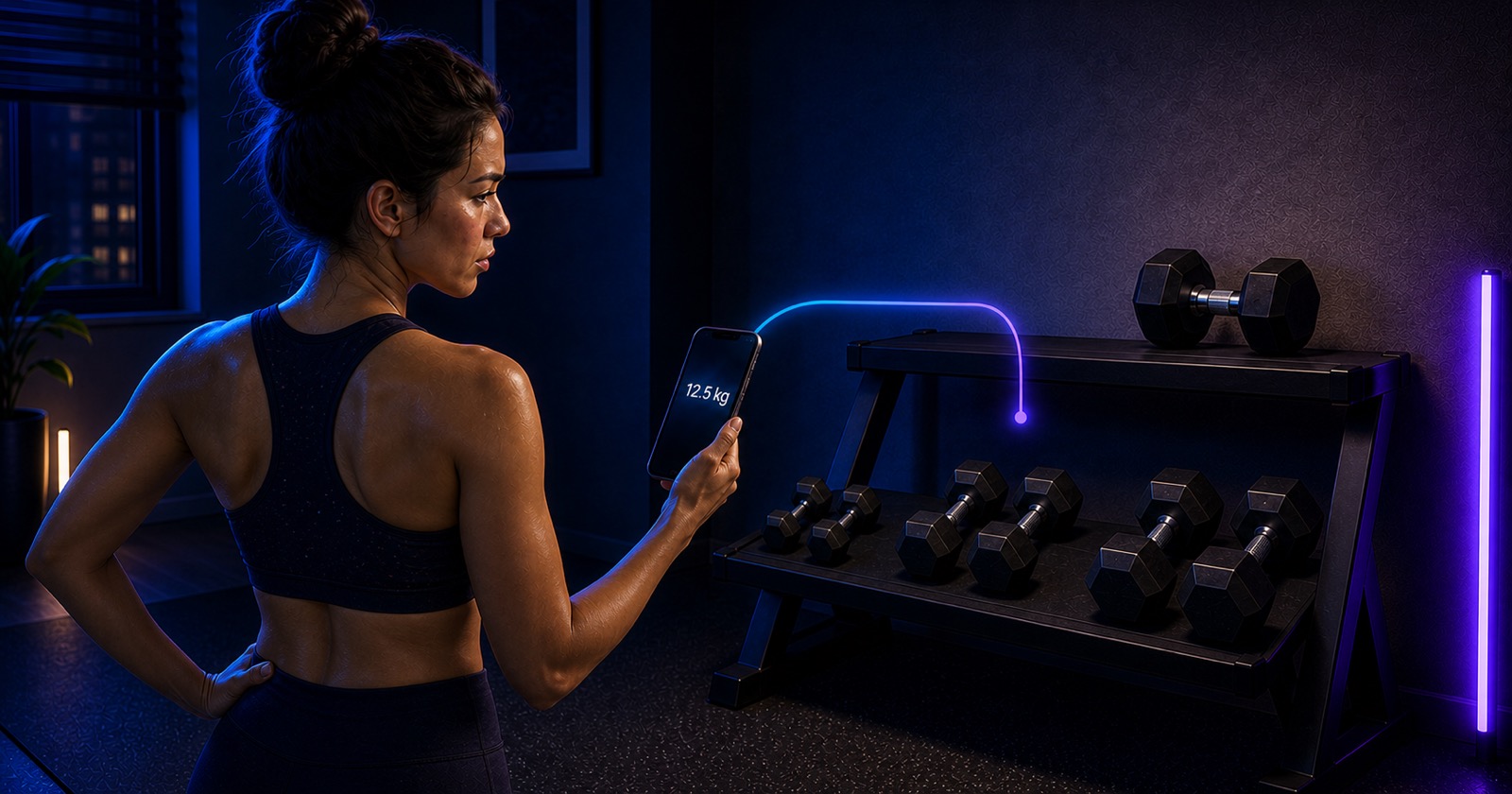
A commercial dumbbell rack may offer almost every useful step. A home collection usually does not. You might own a pair of 5 kg dumbbells, one 10 kg dumbbell and a pair that tops out at 15 kg. That is enough for a great deal of training—but only if the plan understands the gaps.
A generic app sees “dumbbells available” and may prescribe 12.5 kg in each hand. The exercise exists. The equipment category exists. The requested load does not.
The equipment list was missing one important fact
Until now, marking a dumbbell, kettlebell or barbell as available could imply an effectively unlimited set of weights. AnyGear's new equipment-aware load system can describe what a location actually contains:
- Maximum: the heaviest usable weight, including how many matching implements are available.
- Range: a minimum, maximum and real adjustment step.
- Fixed weights: the exact weights and quantities on the rack.
- Unbounded: the backward-compatible default when no limit is needed.
The first version focuses on free weights: dumbbells, kettlebells, barbells and separately used plates. For barbell exercises, the profile describes available total load rather than asking you to maintain a plate-by-plate inventory.
Never round an unavailable target upward
The central rule is deliberately conservative: choose the heaviest feasible option that does not exceed the intended target.
- A target of 12.5 kg per dumbbell becomes 10 kg when your pair stops there.
- A target of 18 kg becomes 17.5 kg in a 2.5–20 kg adjustable range with 2.5 kg steps.
- A two-dumbbell exercise cannot use a weight for which only one dumbbell exists.
- If even the lightest available option is too heavy, the system should choose a verified alternative or leave the exercise out—not force the load.
Quantity matters as much as the number printed on the weight. If your fixed set contains two 5 kg dumbbells but only one 10 kg dumbbell, 10 kg may be valid for a one-arm exercise and unavailable for a movement that requires a matching pair.
One constraint follows the whole workout
The load profile is not just a filter applied during generation. AnyGear stores an equipment snapshot with the planned exercise so the same rule can guide working sets, warm-up sets, substitutions, AI Coach suggestions and the weight controls used while logging.
If a not-yet-started workout was built before the equipment profile became stricter, it can be reconciled downward when opened. An active workout remains frozen, because changing the meaning of a session after it has begun would make the log harder to trust.
Reaching the top of the rack is not the end of progression
More weight is one way to progress, not the only one. When the available load has reached its ceiling, AnyGear can look for a reviewed harder variation or advance repetitions within a bounded range. It does not automatically add endless sets, and equipment logic does not override recovery or injury safeguards.
This is especially useful at home: your plan can continue to create a meaningful challenge without pretending that a new pair of dumbbells appeared overnight.
You can still log what really happened
A location profile should improve recommendations, not rewrite reality. If you borrow a heavier weight or train somewhere with an extra implement, you can still enter the actual load. AnyGear keeps it in the training history and marks it as outside the saved equipment profile. The next plan for the original location still respects that location's limits.
Set up a small home collection honestly
- Open the equipment assigned to your home location.
- Choose maximum, adjustable range or fixed weights.
- Enter quantities as well as weights for dumbbells and kettlebells.
- Use total available load for a barbell.
- Leave the profile unbounded when a precise limit would add no value.
A short, honest inventory is better than a fictional full rack. The goal is not to make limited equipment look unlimited. It is to make every recommendation possible with the equipment you actually own.
Evidence note
The American College of Sports Medicine's progression position stand describes progressive overload through multiple program variables and recommends increasing load when repetitions exceed the target range. That load increase is not always possible with a small home collection.
Two controlled studies compared progression through added load with progression through added repetitions. An eight-week trial in resistance-trained adults and a ten-week within-subject trial in previously untrained adults both found that either strategy could improve measured muscular outcomes in their study settings. A broader systematic review and meta-analysis found similar hypertrophy across loading ranges when sets were taken to momentary failure, while heavier loads favored maximal strength gains.
These sources support flexible progression principles; they do not validate AnyGear's specific equipment-matching algorithm or make every light load interchangeable with heavier training. Exercise choice, effort, technique, goals and individual capacity still matter.