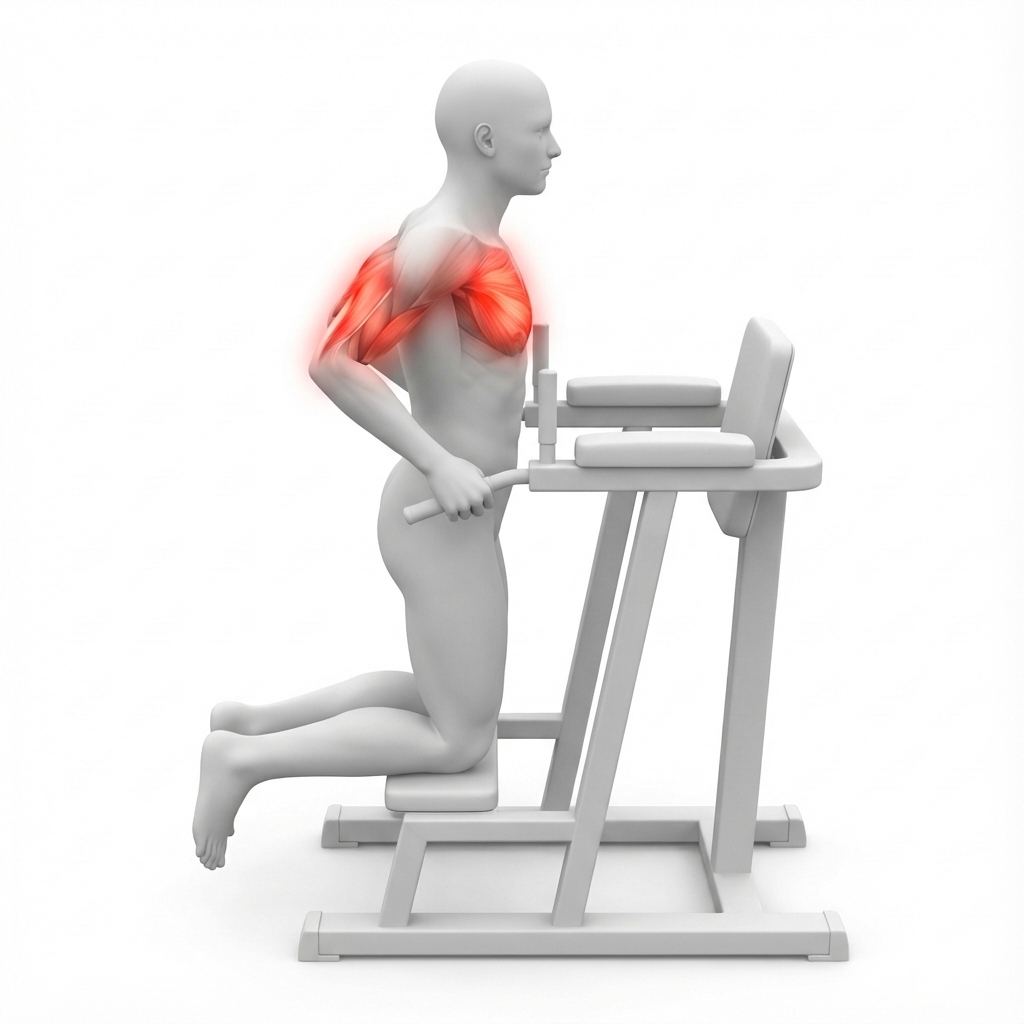
Assisted Dip
Lower and press your body between parallel supports with the chest, shoulders and triceps. Assistance lets you practise the full path with less bodyweight resistance. Main target: chest. Also working: shoulders, triceps. Starting point: 3 × 6–10 repetitions.
Instructions
Setup
- Inspect the machine and all pins, pads or stops. Choose a conservative first load and make sure you can leave the position safely.
- For Assisted Dip, keep the implement, grip, support and direction shown by the name and, when available, the image. If that setup is unavailable, choose an offered alternative instead of improvising another exercise.
- Grip securely, keep the neck long and set the shoulders away from the ears before you descend.
Execution
- Bend the elbows under control, stop before the shoulder rolls forward, then press to a strong but unforced lockout.
- Use only enough assistance to keep every repetition smooth; assistance changes the load, not the movement path.
Range, tempo and breathing
- Perform 3 × 6–10 repetitions. Lower for about 2–3 seconds, change direction without bouncing and lift in 1–2 seconds unless the plan sets another tempo.
- Brace before the effort. Exhale through the controlled lifting or shortening phase and inhale during the return without losing position.
Common mistakes and prevention
- Do not sink passively between the shoulders or bounce from the bottom. Add assistance or shorten the depth first.
Regression and progression
- Use more assistance and, if needed, a smaller controlled range.
- Reduce assistance in small steps only after every repetition stays smooth; never confuse less assistance with less total effort.
Stop signals
- Stop for sharp or increasing pain, numbness, dizziness, chest pain, unusual shortness of breath or loss of control. Swap the exercise if a comfortable, controlled version is not available.
Add to your plan
AnyGear can automatically schedule this exercise when your chest is recovered.